

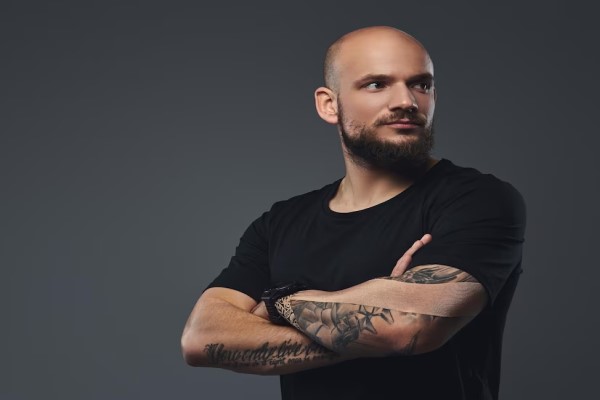
Few trends in men’s grooming are as captivating as the connection between baldness and thick beard growth. This intriguing combination stands out across cultures. The bald, bearded man has become a timeless archetype. His appearance sparks both curiosity and admiration. This iconic look raises an intriguing question: why bald men have a lot of beards?
Human biology often presents fascinating patterns. These patterns provoke curiosity and spark discussions. One such pattern is the frequent pairing of bald men with a lot of beards. This phenomenon has intrigued researchers for years. In addition, the relationship between these two traits has fueled debates. Scientists and social observers alike explore genetics, hormonal influences, and evolutionary theories to understand it.
Why do bald men have a lot of beards? A quick explanation

Baldness, or androgenetic alopecia, affects a substantial portion of the male population as they age. The primary focus has traditionally been on scalp hair loss. In addition, some bald men have a lot of beards, and thick ones. This striking juxtaposition raises questions about the biological mechanisms, genetic influences, and hormonal factors behind this pattern.
Over the years, researchers have proposed several theories to explain why bald men have a lot of beards. These range from evolutionary advantages to hormonal interactions. Understanding this phenomenon enhances our knowledge of genetics and biology. It also highlights how the body adapts to internal and external stimuli, showcasing the complexity of human physiology.
The evolutionary context for bald men with a lot of beards
To understand why bald men have a lot of beards, it’s important to examine human evolutionary history. Throughout evolution, traits have been shaped by selection pressures that influenced survival and reproduction. The causes of baldness is still in debate. However, some researchers suggest that male pattern baldness may reflect natural selection favoring traits like reduced risk-taking and increased wisdom in older men.
Facial hair, from an evolutionary viewpoint, conveys age, health, and masculinity. A full beard can signal sexual maturity and dominance. That may have provided advantages in mate selection and social hierarchies. In bald men, a thick beard might act as a compensatory feature, emphasizing these traits despite the absence of scalp hair.
Why can’t I grow my beard?

General patterns and explanations offer valuable insights. However, biology rarely follows strict rules. The variability in responses to hormones, genetic factors, and environmental influences leads to vast diversity in human appearances. Not all bald men will have substantial beards. Similarly, not all men with full heads of hair will lack facial hair.
Recognizing the paradox of individual variation reminds us that physical traits arise from a complex interplay of factors. Many of these factors are not fully understood. This diversity adds to the intrigue of the phenomenon and highlights the intricacies of human biology.
In exploring why bald men have a lot of beards, a mosaic of scientific knowledge, cultural perspectives, and personal experiences emerges. Evolutionary advantages of facial hair, hormonal intricacies, and genetic influences contribute to this bald men having a lot of beards. It reminds us that our bodies result from a blend of nature and nurture, creating uniqueness in each individual.
Causes for bald men having a lot of beards
Different sensitivity to DHT
Hormones play a crucial role in shaping various physical characteristics, including hair growth. Specifically, androgens, such as testosterone, are key in influencing both male pattern baldness and facial hair growth. Elevated levels of dihydrotestosterone (DHT), a derivative of testosterone, are often associated with hair loss on the scalp.
Interestingly, the same hormones that contribute to scalp hair loss can also stimulate growth in other areas, like the face. However, the sensitivity of androgen receptors varies across different regions of the body. This explains why some men experience contrasting hair growth patterns. As a result, the flourishing beard seen in some bald men may be due to the selective responsiveness of facial hair follicles to androgenic signals.
Genetic influences

Genetics significantly impact hair growth patterns. In fact, the genes responsible for both baldness and beard growth are influenced by a complex mix of hereditary factors. Studies show that these genes are not strictly linked, meaning that baldness does not always predict the presence of facial hair.
Moreover, certain genetic variations could encourage facial hair growth, even as baldness progresses. For instance, variants in genes related to androgen receptors and hormone metabolism may explain the unique combination of a bald scalp and a full beard.
Androgen receptor activity
The influence of DHT on hair growth is intricately mediated by androgen receptors located within the hair follicles. These receptors play a pivotal role, as their quantity and activity can differ significantly between facial and scalp hair follicles.
In facial hair follicles, the presence of a higher number of androgen receptors, along with their increased activity, can intensify the stimulating effects of DHT. This enhanced responsiveness can result in notably more vigorous and robust beard growth, giving rise to a thicker, more lustrous facial mane.
Lifestyle choices
Nutrition also plays a crucial role in maintaining healthy hair growth. A balanced diet rich in vitamins, minerals, and proteins can support optimal hair health. On the contrary, deficiencies in key nutrients, such as iron or vitamins A and D, may negatively affect hair follicles.
Moreover, lifestyle choices can impact both beard growth and the tendency to experience baldness. Smoking and excessive alcohol consumption, for instance, can impair circulation and reduce the supply of essential nutrients to hair follicles, potentially exacerbating hair loss.
Age

Dihydrotestosterone (DHT) begins to emerge during puberty, initiating a complex relationship with hair growth that evolves as one ages. For many men, beard growth does not reach its full potential until later in life; it often continues to mature, becoming denser and more widespread into adulthood. This gradual development can lead to a fuller, more pronounced beard over the years.
In contrast, for those genetically predisposed to male pattern baldness, hair loss on the scalp can also become increasingly evident with age. This contrasting dynamic can highlight the differences in hair density and coverage between facial hair and scalp hair, creating a striking visual juxtaposition as time passes.
Other factors
While the primary drivers of beard growth and baldness are largely determined by genetics and hormonal sensitivity, other factors may also contribute to the overall contrast between the two. For instance, an individual’s overall health can have a noteworthy impact on hair growth patterns. Conditions such as stress, hormonal imbalances, and underlying medical issues can influence both beard development and hair loss on the scalp.
These factors play a less direct role compared to genetics and hormonal sensitivity. However, they can still significantly influence the extent to which a person experiences beard growth in contrast to baldness.
Cultural significance and identity of bald men with a lot of beards
Beyond scientific explanations, baldness and facial hair carry significant cultural and personal meanings. Across history, societies have assigned various interpretations to these traits, shaping perceptions of masculinity, wisdom, and virility. In many cultures, a smooth, bald head paired with a full beard symbolizes power, authority, and maturity. This combination reflects both physical strength and intellectual depth, often seen as a sign of societal respect and dominance.

For many men, facial hair goes beyond appearance; it becomes a powerful form of self-expression. The distinctive pairing of a bald head and a robust beard creates a unique visual identity, standing out in a world dominated by conventional beauty standards. For some, embracing a thick beard is empowering, allowing them to reclaim their masculinity and attractiveness. This challenges societal norms and celebrates individuality and personal empowerment.
Faq’s
Why do bald men have a lot of beards?
Bald men often grow beards as a way to enhance their facial features and compensate for the lack of hair on their heads. A full beard can create a balanced look and boost confidence.
Do all bald men have the same type of beard growth?
No, there is a range of variation. Some bald men may be able to grow a full, lush beard, while others may only achieve a more patchy or sparse facial hair growth. Genetics, grooming habits, and lifestyle factors can all influence the specific characteristics of a bald man’s beard.
Is there a connection between baldness and other body hair growth?
Not necessarily. The increased facial hair growth experienced by bald men is primarily due to the specific hormonal changes and receptor sensitivity in the facial hair follicles. Other body hair patterns may not be directly affected by the same mechanisms.


Responsable – CAPIL SOLUTIONS. S.L
*Términos y condiciones
Finalidad – Dar respuesta a las solicitudes de información, y poder enviarle nuestras publicaciones, promociones de productos y/o servicios, gestionar los comentarios en el blog
Derechos Arco - Acceder, rectificar y suprimir los datos, así como otros derechos, como se explica en la información adicional.
info@capilclinic.us
Legitimación – Consentimiento
Destinatarios – No se cederán datos a terceros salvo obligación legal
Política de privacidad – Puede consultar nuestra política de privacidad aquí
*Política de privacidad